Xinhua News Agency, Hohhot, May 9th, Title: "New Youth" for sand control and desert control "painted an oasis" in the depths of the desert
Xinhua News Agency reporter Hou Weiyi
Depth of summer, deep in the Ulan Buhe Desert, members of the Sanbei Sand Control Youth Commando in Dengkou County, Bayannur City, Inner Mongolia Autonomous Region, were wearing light green vests, waving shovels in their hands, and planting sand control plants such as saxalaxies and sea buckthorns in the wind and sand. Not far away, rows of tender green seedlings and bright team flags complement each other.
"Since mid-March this year, we have been pressing grass grids in the Ulanbuhe Desert to fix quicksand; afforestation will begin in late March, and it is expected to last until the end of May." He Wenqiang, a member of the Sanbei Desert Control Youth Commando in Dengkou County and deputy director of the Sand and Desert Control Bureau of Dengkou County, said that this year the commando plans to lead and guide the surrounding people to complete the project of sand pressing and shrub afforestation of 93,000 mu, and 80% has been completed.
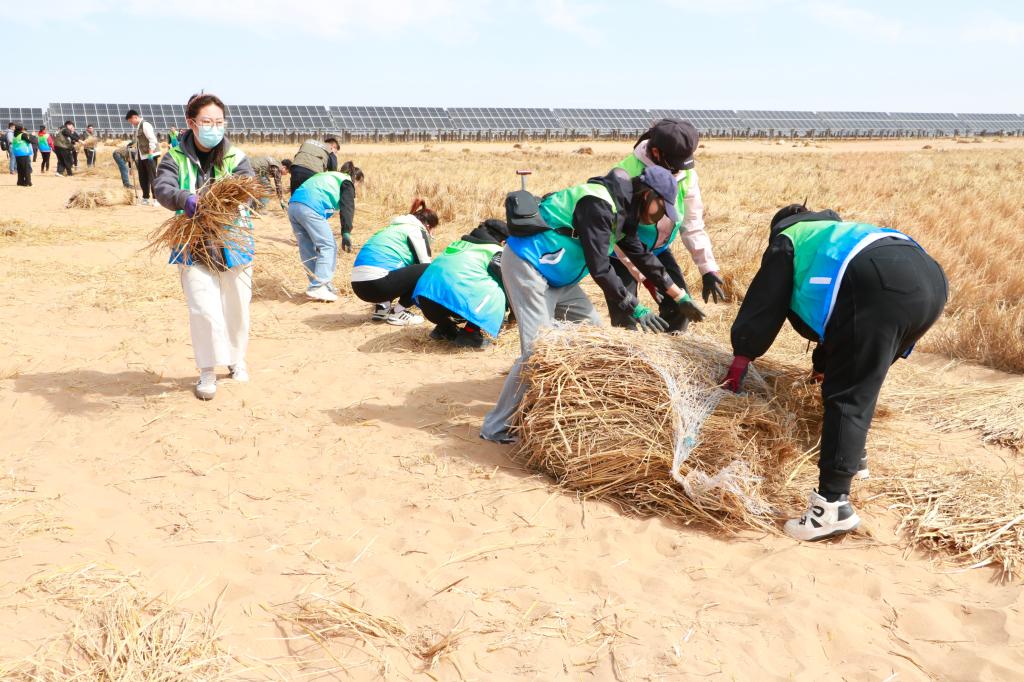
Members of the Sanbei Sand Control Youth Commando in Dengkou County, Bayannur City, Inner Mongolia Autonomous Region are laying out sand pressing materials. (Photo provided by the interviewee)
The total area of the Ulan Buhe Desert is 15 million mu, of which 4.269 million mu are distributed in Dengkou County, Bayannur City. In the 1950s, facing the serious problem of desertification, Dengkou County established the first generation of young sand control commando teams. The team members struggled in the desert, opened canals and planted trees, and explored methods to use clay and firewood to fix sand. After years of hard work, the commando built a sandproof belt on the east side of the Ulanbuhe Desert to effectively curb the desert's invasion.
"The wind and sand in the desert are large, the temperature difference between day and night is also large, and the environment is very harsh. In addition, afforestation is a physical job, so young people who are full of vitality and physical strength are always the 'main force' of our desert control team." He Wenqiang said.
From the establishment of the first generation of desert control youth commando in Dengkou County, generation after generation of young people have joined the commando for more than 70 years, taking over the baton of sand prevention and control, and building and protecting the "green barrier" of the northern border of the motherland.
Now, the Dengkou County Sanbei desert control youth commando has a total of 42 members, of which 28 are young people under the age of 35, accounting for 66%. It is a vibrant desert control team.
"With the deepening of sand prevention and desertification control work, our team's division of labor has become more meticulous, and a science and technology innovation group, technical guidance group, publicity and reporting group, and resource protection group have been established." Wu Yanjie, captain of the Three Norths of Sand Control Youth Commando of Dengkou County and director of the Sand Control and Desert Control Bureau, introduced that each group is responsible for important tasks such as sand prevention and desertification control technology innovation, technical guidance, news publicity, forest and grass resource protection.
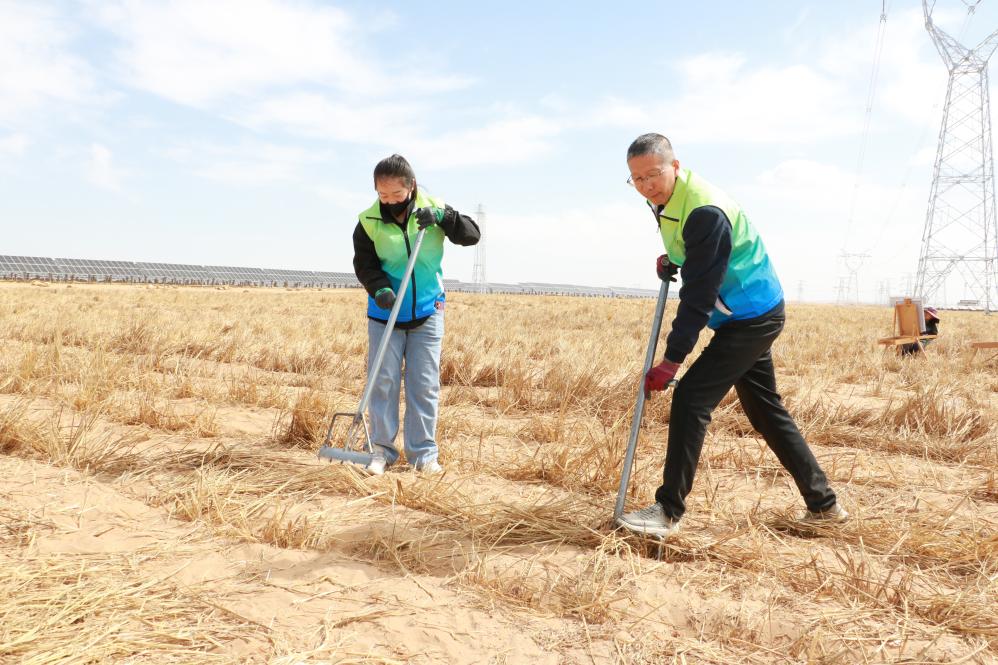
Members of the Sanbei Desert Control Youth Commando in Dengkou County, Bayannur City, Inner Mongolia Autonomous Region are suppressing the grass grid. (Photo provided by the interviewee)
In the desert control youth commando, Wang Danyang, a post-90s generation, is a member of the science and technology innovation group. Her other identity is a scientific researcher at the Desert Forestry Experimental Center of the Chinese Academy of Forestry Sciences.
Five years ago, after Wang Danyang graduated from the Grassland Institute of the Chinese Academy of Agricultural Sciences, he came to work on the front line of sand prevention and control. "Measuring the growth status of sandy plants, collecting soil samples, and analyzing the physical and chemical properties of the soil are the work I often do." Wang Danyang introduced that screening out sandy plants with tenacious vitality and suitable for growing locally is a basic task in sand prevention and control.
In addition, another work Wang Danyang participated in was field investigation. "By investigating plant community diversity, sand control can be carried out more targetedly," said Wang Danyang.
Now, more and more young talents like Wang Danyang have joined the desert control youth commando and taken root in the front line of sand control in the western part of the motherland. They applied modern scientific and technological means such as drone aerial photography, remote sensing monitoring, and big data analysis to sand control practice, developed new technologies such as afforestation of native desert tree species, high-pressure water hole afforestation, and refrigerated seedlings and sheltering wind afforestation, and painted a "green picture" in innovation.
With generations of young sand control commandos and local people, the forest and grass coverage in Dengkou County has increased from 0.04% in the early 1950s to 39.1% at present, and the number of sandstorm days in the county has decreased from 23 days in the 1990s to about 8 days now.
Not long ago, the Dengkou County Sanbei desert control youth commando won the 2025 China Youth May Fourth Medal Collective. "This honor is an affirmation of the hard work of the team members, and it also inspires us to continue to do a good job in sand prevention and control." He Wenqiang said that in the future, the commando must also use scientific and technological means of desert control, strengthen confidence, persevere, and use the vitality and wisdom of young people to spread and extend more green on the northern border of the motherland.