Xinhua News Agency, Tianjin (Reporters Zhang Jianxin, Li Yating) The team of Liu Shulin, a researcher at the School of Chemistry at Nankai University in China, has recently successfully developed a new broad-spectrum anti-influenza virus path. This strategy fundamentally disrupts the evolutionary advantage of the virus by synchronously degrading multiple key components at the core of viral replication, laying a solid foundation for the development of the next generation of potent, durable and broad-spectrum anti-influenza drugs. Relevant research results were recently published in the international academic journal "Journal of the American Chemical Society".
According to the research team, influenza A viruses can easily evade host immune responses and existing drugs due to their high mutation rate. Current clinically used antiviral drugs can usually only target a single target of the virus, which makes it easy for the virus to develop drug resistance through mutation, resulting in a greatly reduced drug effect and limited broad-spectrum efficacy. New treatment strategies are urgently needed worldwide.
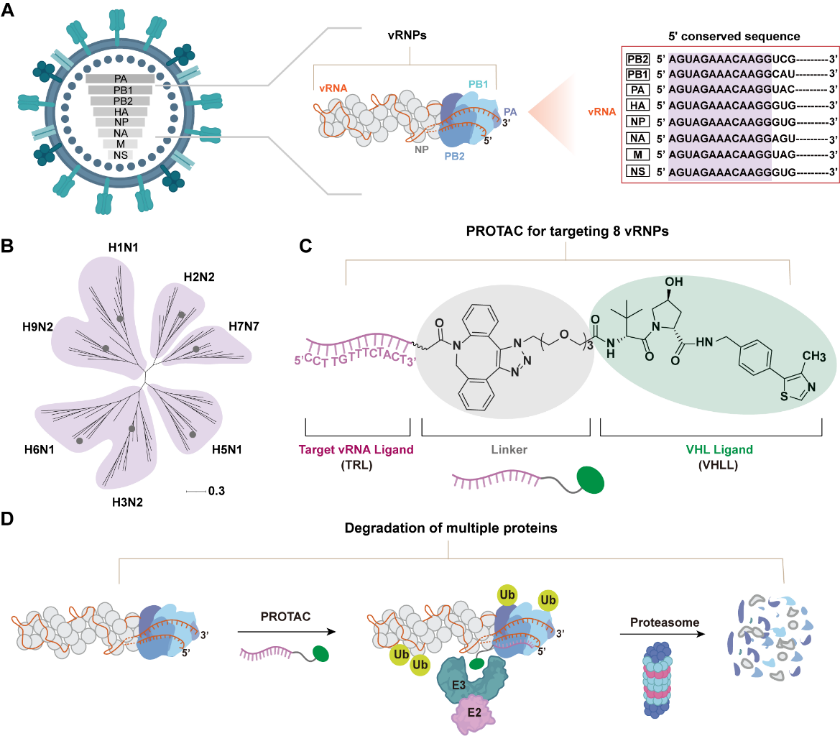
Schematic diagram of PROTAC-mediated degradation of multiviral proteins. Xinhua News Agency reported that Liu Shulin introduced that the team developed an anti-virus strategy called "Multiplex PROTAC". Its core mechanism lies in the clever use of a highly conserved 5' untranslated region in the targeting viral RNA, which is regarded as the "universal code". Based on this, researchers from their team designed a multifunctional PROTAC molecule. One end of the molecule can accurately recognize and bind the virus's "universal code", and the other end is responsible for recruiting the proteasome, the inherent protein degradation system in human cells. This design makes the molecule act like a "Trojan horse". After entering an infected cell, it can hook onto the viral ribonucleoprotein complex, the core of viral replication, and the cell's "crusher" at the same time, thereby marking the core protein of the virus as a "destruction" mark, and then guiding the cellular machinery to completely degrade these key parts for viral replication, destroying the virus' replication ability from the source.
The team’s experimental results show that the multiple PROTAC strategy exhibits excellent antiviral performance. Not only can it effectively inhibit viral replication in a concentration-dependent manner, but its inhibitory effect can last for more than 48 hours. Its persistence and efficacy are significantly better than single-target control drugs. What is particularly critical is that this strategy successfully builds a high genetic resistance barrier by synchronously degrading multiple viral proteins. This means that if the virus wants to escape, it must have effective escape mutations on multiple key targets at the same time. This sets up an insurmountable obstacle for the virus in natural evolution and reduces the risk of drug resistance. Furthermore, this strategy showed broad-spectrum activity against multiple influenza strains, highlighting its potential as a broad-spectrum anti-influenza drug.
The reviewers commented that the versatility of this strategy also provides a new technical path and imagination space for dealing with other rapidly mutating viruses in the future.